
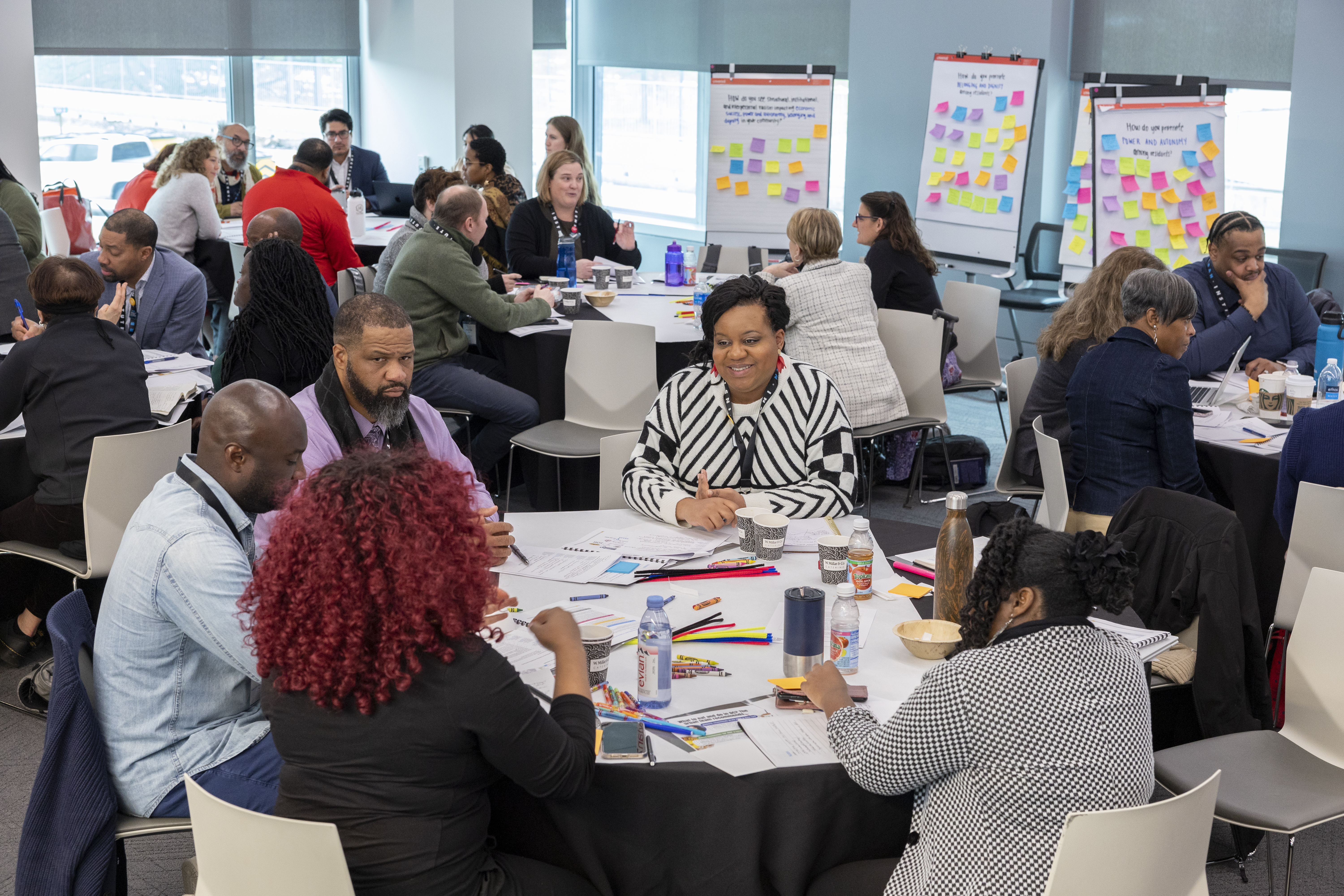
When communities come together around a shared vision, they can create the conditions where every person has a real opportunity to thrive. Evidence has shown that people experiencing poverty face a complex web of structural and systemic barriers that often impedes and undermines their best efforts. Addressing these barriers requires that stakeholders come together to create a comprehensive approach to advance upward mobility in their community.
At our recent virtual workshop, we hosted Mobility Action Learning Network members from Santa Barbara, California, and the Alexandria, Virginia, who shared how they’re advancing upward mobility by building durable, cross-sector coalitions.
Although Santa Barbara is often perceived as an affluent area, in 2021, the Public Policy Institute of California reported that Santa Barbara had the second-highest poverty rate among California’s 58 counties. In response, partners from CommUnify, Santa Barbara City College, the Santa Barbara Foundation, the County of Santa Barbara Department of Social Services, and the Housing Authority of Santa Barbara formed a Mobility Action Coalition.
Similarly, Alexandria’s coalition emerged from their Arise guaranteed income pilot, which provided $500 per month for 29 months to 170 individuals. Though the pilot was effective, city leaders recognized the need for a broader, systemic approach to upward mobility. To address barriers to upward mobility, the Alexandria Department of Community and Human Services, ACT for Alexandria, ALIVE!, and Neighborhood Health established a coalition.
Here are three lessons they shared.
Use narrative to inspire community action.
A powerful narrative that explains challenges to opportunity and how to address them can inspire community action and mobilize partners. In Santa Barbara County, Julie Weiner, chief development officer at CommUnify , shared that using the positive framing of “upward mobility ” brought more stakeholders to the table, enabling their coalition to grow from 5 organizations to more than 15 during their time partnering with Urban as part of the Mobility Action Learning Network.
Their coalition went on to host a successful Upward Mobility Summit, convening 350 community members, private organizations, elected officials, and philanthropic leaders to inform their mobility action planning groups that will develop recommendations to improve upward mobility conditions in their county.
Similarly, Julie Mullen, economic mobility program officer from Alexandria, Virginia, emphasized that narrative isn’t just words, it’s “all the data the data points that come together to weave a common story,” that humanizes people experiencing poverty and unites diverse partners around shared goals.
Center resident voice to guide priorities.
Both communities emphasized intentional, structured engagements with residents to ensure coalitions remain grounded in residents’ lived experience, not institutional assumptions. Mullen emphasized that “resident voice is really the ultimate clarifier, unifier, and motivator for [them].… It gives [them] clarity about [their] work and the barriers residents face.” To engage residents, the Alexandria coalition conducted a participatory process to define what “crisis,” “instability,” “mobility,” and “stability” mean for the community. They also ran a six-question conversation survey on the street to understand residents’ feelings about economic security and their hopes. They also used community input to inventory existing local resources along a spectrum of financial stability to identify gaps and opportunities for investment.
Weiner explained that the Santa Barbara coalition worked to integrate resident feedback primarily through listening sessions designed to capture the perspectives of low-income residents. Though they had planned in-person sessions, a wave of federal immigration raids created heightened concerns around gatherings, so they pivoted to five smaller, virtual sessions. The feedback revealed significant barriers connected to an individual’s history of justice involvement, which informed their work that draws from the Upward Mobility Framework to address conditions that affect residents’ mobility in relation to fair and just governance. The process highlighted how much of what residents face is shaped by national factors, not just local conditions.
Focus on sustaining your coalition over time.
Coalition building is dynamic, resource-intensive work that requires clear ownership, ongoing communication, and the ability to revisit and refine the purpose of the coalition as conditions change. As Urban’s Joe Schilling explained in the workshop, sustaining a coalition requires long-term resilience and adaptability rather than just funding. Embedding coalition work into existing systems and structures so it doesn’t rely on short-term grants or external support is one way to ensure strategies are sustainable from the start. This might mean aligning goals, priorities, and practices within members’ existing strategic plans or scope of work. If members can achieve their own missions while advancing the coalition’s goals, they are more likely to stay engaged. Mullen emphasized that the Alexandria coalition started small with trusting partners and built their network gradually to make sure they could sustain momentum. From there, they “position[ed] [themselves] where the action is.… Always having something that adds value keeps people engaged.”
The structural and systemic barriers that keep residents from achieving upward mobility require collective action and sustained collaboration. These examples from Santa Barbara County and the City of Alexandria highlight how narrative can inspire action, how centering resident voice is critical in informing strategic priorities, and that sustaining coalitions is about more than just funding but also creating a culture of resilience. If you are interested in learning more about ways to form and sustain an upward mobility coalition visit Urban’s Toolkit for Increasing Upward Mobility in Your Community.
