
This week, the Bill & Melinda Gates Foundation announced substantial new investments to advance economic mobility and opportunity in the United States. The Urban Institute is proud to be among the foundation’s anchor partners, building and sharing knowledge changemakers need to accelerate solutions that increase upward mobility and promote equity.
Urban has been a partner in this work since 2016, when the foundation invited us to organize and host the US Partnership on Mobility from Poverty to inform a potential new initiative on economic mobility and opportunity. The Partnership capitalized on Urban’s deep research expertise and our commitment to evidence-based policy, bringing together a remarkable group of leaders to learn, deliberate, and offer solutions to an urgent and compelling question:
What would it take to dramatically increase mobility from poverty in the United States?
What we mean by upward mobility
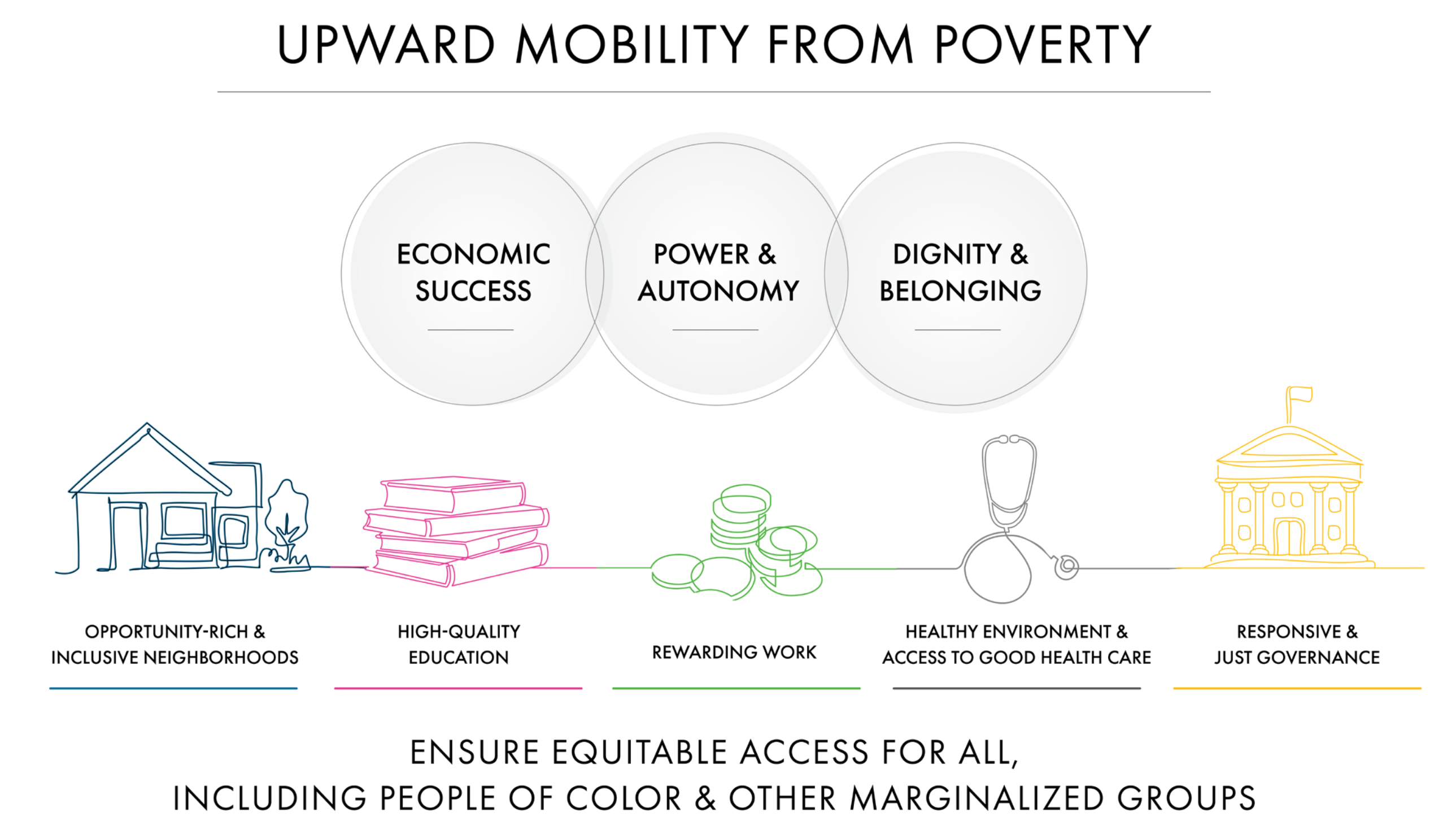
One of the Partnership’s most compelling insights is that upward mobility is about more than money. Economic success is certainly a critical component, but it’s not enough. Real upward mobility means people can exercise individual autonomy over choices in their own lives and can wield collective power over policies and practices that shape their circumstances. Real mobility also requires that people experience the dignity of being valued for the contributions they make to their family, work, and community.
Increasing upward mobility for everyone in the US—especially people and communities who have been historically denied economic success, power, and dignity—lies at the core of Urban’s mission. We equip changemakers with the evidence and solutions they need to increase upward mobility, create communities of opportunity and shared prosperity, and build a just and equitable society.
Dual commitments to upward mobility and racial equity
Communities across the country want to address the intertwined challenges of mobility and equity. When this work began, Raj Chetty’s research had galvanized national attention with evidence that economic mobility was stagnant or even declining in the US. In response, many communities and organizations committed themselves to the long-term goal of substantially increasing upward mobility.
Then, in 2020, George Floyd’s murder forced a national reckoning with profound racial injustices—not only in policing but throughout American society. This made explicit that ensuring upward mobility for all means tearing down the barriers that have systematically blocked the efforts of Black people and other people of color.
Tools for assessing progress
Many local leaders across the country have committed to increasing upward mobility from poverty. But it can take decades to observe changes in generational mobility—to know what’s working and whether we’re making progress. So the foundation asked Urban to develop a concise but comprehensive set of metrics local leaders could use to assess progress in the short to medium term. With the help of a scholarly working group, we developed an Upward Mobility Framework that identifies the pillars of support individuals and families need to achieve economic success, power, and dignity and offers a set of predictors and metrics that are backed by strong evidence and can be influenced by local and state policies.
Supporting changemakers
We vetted the working group’s conclusions with hundreds of stakeholders from the nonprofit, government, business, and philanthropic sectors and “beta tested” the metrics with partners in eight counties and cities over 18 months that applied the metrics to develop local Mobility Action Plans. The metrics are available online for all US counties and for cities with populations over 75,000. Urban is now advancing work to promote awareness, adoption, and impact of the Upward Mobility Framework and metrics, including delivering technical assistance to more communities and networks across the country.
I’m immensely proud of how this work builds on Urban’s strengths and reflects our aspirations for the impact we want to achieve. Our work in partnership with the Bill & Melinda Gates Foundation is grounded in our shared commitment to evidence and our reputation for rigorous knowledge building. It leverages Urban’s breadth of substantive expertise on policies that shape jobs, housing, health, wealth, and justice. It capitalizes on our capacities to build and share knowledge that’s actionable—through technical assistance, strategic communications, and stakeholder engagement. And it stretches us to make real our commitments to equity and inclusion in all the work we do.
